
Travelling journal Ghana February 2026 1/6
Updated: Mar 26

EWIA CEO Ralph Schneider is currently traveling in Ghana with employee Jonathan Baumann. Read on to find out what their day looks like, who they are meeting, where, when, and why.
Day 1: February 9, Monday
We set off at 5:25 a.m. We drive to Munich Airport. At this time of day, the journey takes 40 minutes. It is dark and rainy, but there is already a lot of traffic on the roads. I say goodbye to my wife Karin and my family. I will be away for another three weeks. Another three weeks in Africa. Including two weekends.
Flight from Munich to Brussels. Transfer, passport control, flight to Accra. This time, the flight goes via Cotonou in Benin. That means it takes around nine hours from Brussels instead of the usual 6.5 hours. A long day. Travel days to and from Africa consist mainly of waiting, sitting, waiting, sitting, and waiting again. We wait at security. We wait to check in and board, we sit in the plane for a long time. We wait again during stopovers, wait until we can disembark. Wait at passport control. Wait at the baggage carousel. Door to door, we were on the road for around 17 hours.
Bye, bye, Winter in Germany
Nana, our Managing Director in Ghana, picks us up at the airport. In Germany, it was around 0°C. Here in Accra, it's 28°C at 10 p.m., which is 11 p.m. German time. For Jonathan, our young Executive Assistant, this is his second major trip to Africa. What is exciting new territory for him is a lot of tedious routine for me. How many times have I been to West Africa? Thirty, forty times, or was it more than fifty trips – to West Africa alone? Each time I was on the road for two to three weeks, sometimes four weeks or longer. All in all, I have spent several years in West Africa. A lot of waiting, a lot of amazement.
We arrive at the Company House in Accra at 10 p.m. Our housekeeper Naomi has prepared something for us to eat. A first technical check: the air conditioning and water are working. However, the fan on the terrace has given up the ghost. Time to go to sleep.
Day 2: February 10, Tuesday
Our board meeting starts again at 8:00 a.m. Online. At 7:45 a.m., I received a call from one of our EPC companies. Our ACARP project, the organic composting and recycling plant in Accra, may require some rescheduling. At moments like this, the question arises: Does a CEO just read the reports—or does he intervene on site?
Time is flexible in Africa
The time difference between Germany and Ghana is currently one hour. During daylight saving time, it is two hours. Whenever you make an appointment, you have to think about what time is actually meant. My African colleagues often find it difficult to make detailed arrangements regarding time. At 9:30 a.m. sharp, we have our online marketing meeting, followed by the team meeting. Introducing new colleagues. Rohda, a young engineer, has just started working with us. It's a surprise for me to see a new face, especially since Rohda has taken a seat right across from me. Apparently, the last person to arrive has to sit with the boss.
This is followed by an intensive budget meeting with the Ghanaian management team. We grab breakfast in between. In the afternoon, we have our quarterly reporting meetings on the agenda.
At the same time, I am already preparing the presentation for the shareholders' meeting on February 18. At around 7:35 p.m. German time, I shut down my computer.
Petrus doesn't stick to the end of the working day
On the way to dinner, we had another surprise. Despite it being the dry season, it started pouring with rain. In our distress, we take refuge in a pub around the corner. It's a sports bar. Most of the guests have also sought shelter inside. Rain in Ghana means at least an internet outage and, above all, a long wait for food. After two hours, it's still raining, but it's bearable. We have to contend with the wet weather as we walk the 500 meters to the Company House. Our first day in Accra comes to an end.
DAY 3: Wednesday, February 11
I've been sitting at my computer again since 7:45 a.m., surrounded by our team. After yesterday's rain, the expected internet outage occurred. Everything is offline. No access to our server or the cloud. I have to hold our board meeting at 8:00 a.m. Ghanaian time via my smartphone. The connection is very poor and keeps dropping out.
Ghanaian Controlling
I need to discuss a few calculations with the accounting department. The budget planning figures don't add up. There are always communication problems because the way of thinking in Ghana and Germany is completely different. Terms are interpreted differently. What is a budget, a bill, an invoice, a calculation? Most of the time, employees don't dare to say when they don't understand something or have a different opinion. The issue is power distance. Critical discussion is usually non-existent.
No warning signs
At 11:00 a.m., we had to deal with one of the most unpleasant topics imaginable. We had to dismiss an employee because of misconduct that took us completely by surprise. Meetings like this are exhausting and unpleasant. Afterwards, we had to inform the shareholders, determine what measures to take, and establish the appropriate compliance precautions for the future.
Nothing but warning signals
In the evening, I venture back into Accra traffic with the car for the first time. Our rental car has one distinguishing feature above all others: every conceivable warning light flashes and won't go out. It's like an African disco effect. Not a reassuring feeling.
Day 4: Thursday, February 12
Went to bed early yesterday. We had dinner at a Turkish restaurant. I always find it fascinating that all restaurants have their own parking attendants. They help you park and leave and stop traffic so that restaurant guests can drive away comfortably. This also applies to every mall. The attendants take their job very seriously and don't take any nonsense. Even if the entire parking lot is empty, they wave you meticulously and mercilessly into a parking space with centimeter precision. No point in arguing.
Immediate consequences
After yesterday, today's goal was to take appropriate measures. First, we appointed a compliance officer. In future, a KYC process must be carried out for all contractual partners, including subcontractors with an order volume of 5,000 GHS (currently just under 384 euros). It was also important to inform all employees about the events and consequences in a separate meeting.
The morning was again marked by an internet outage. Once again, there was no access to servers and email accounts for hours.
Great interest in the portfolio
At the same time, the quarterly reporting had to be completed in order to comply with legal reporting requirements. The funding campaign for the EWIA Impact Portfolio* Ghana 1 got off to a very successful start. Within 24 hours, we had already exceeded the funding threshold and within 36 hours we had already raised more than €45,000. This is a huge success for us.
Our sales team is responsible for preparing and planning customer and on-site appointments.
Accra is no stranger to luxury
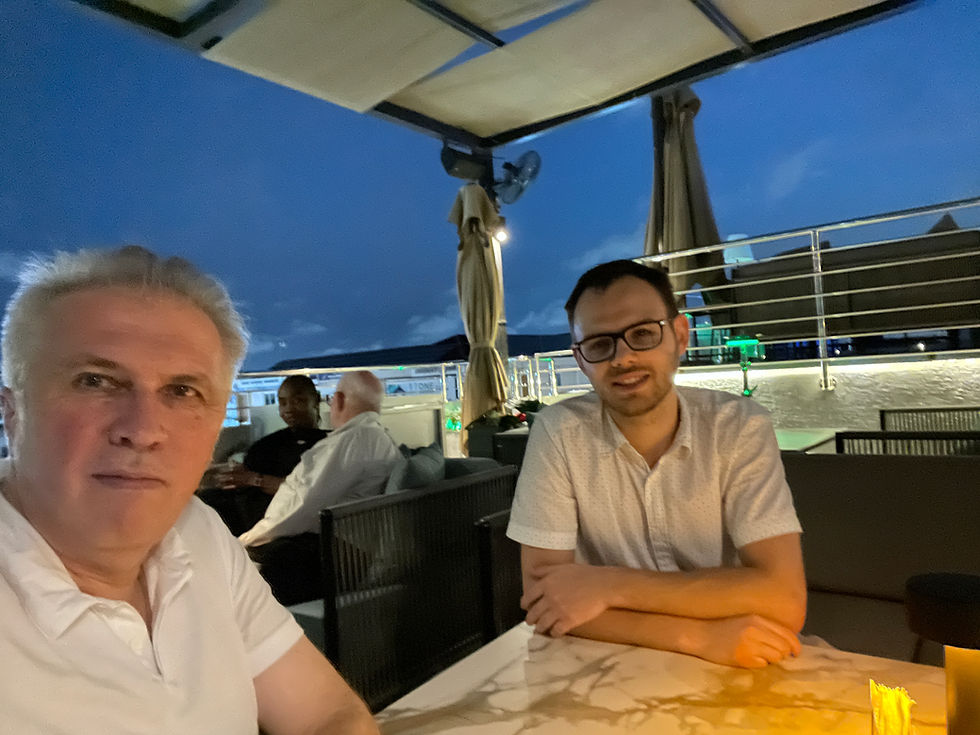
In the evening, we walk to a new restaurant located on a rooftop terrace. The Quattro is geared towards luxury. At the entrance, we are immediately greeted by two hostesses. As white men wearing jackets, we are granted access. We are escorted to the elevator and welcomed on the fourth floor. Without providing my phone number, they would not grant us access. The interior is modern, with seating on the rooftop terrace. There is dedicated service. The menu is only available digitally on a tablet that is handed to you. The prices are substantial, even by Munich standards. Nevertheless, many of the tables are occupied by Ghanaians, the new wealthy elite. Cars from well-known luxury brands are parked in front of the building.
For two people, we pay around 850 GHS for Jonathan's chicken with jollof rice and my somewhat uninspired tuna pizza, two glasses of wine, and a bottle of water. That's around 65 euros, which is more than you would normally be willing to spend for this level of quality. The bill is roughly half of our housekeeper's monthly salary. A glance at the other tables reveals that the bills there will certainly be significantly higher.

Comments